
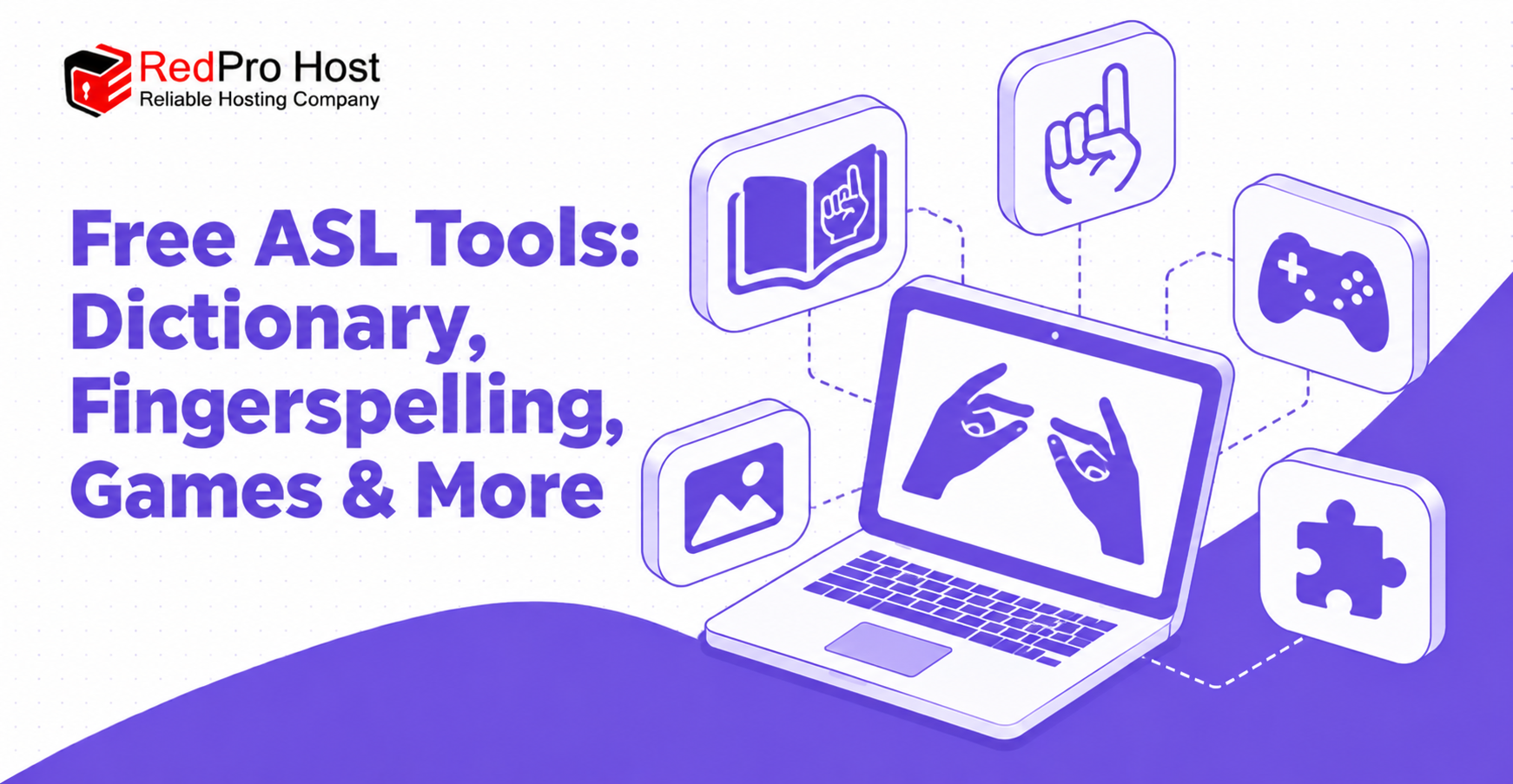
Learning American Sign Language becomes easier when each practice activity has a clear purpose. A visual dictionary can introduce useful vocabulary, a fingerspelling generator can reinforce the manual alphabet, and short games can turn review into an active challenge. Printable puzzles, image makers, and beginner-friendly gloss support can add variety without making the learning process feel overwhelming.
These free ASL tools are designed for beginners, students, families, teachers, and independent learners who want practical ways to search, create, review, and practice. You can start with one sign or word, use the resource that matches your immediate goal, and build a routine over time.
Online tools are most useful when their limitations are clear. American Sign Language is not English represented with hand signs. It is a complete visual language with its own grammar, regional variation, facial expression, body movement, and use of signing space. Digital resources can support study, but they cannot replace fluent signers, qualified instruction, or meaningful engagement with the Deaf community.
Free ASL Tools
Free ASL tools give learners several ways to interact with the same material. Someone can search for a sign, review its meaning, practice fingerspelling a related word, create a visual study card, and finish with a short game or printable activity. This variety helps learners move beyond passive reading and use what they have studied.
Each tool should be chosen for a specific task. A dictionary supports vocabulary lookup, while a fingerspelling generator focuses on letter recognition. A gloss practice tool can introduce written notation, but it does not produce a complete translation. Understanding those differences helps learners use every resource responsibly.
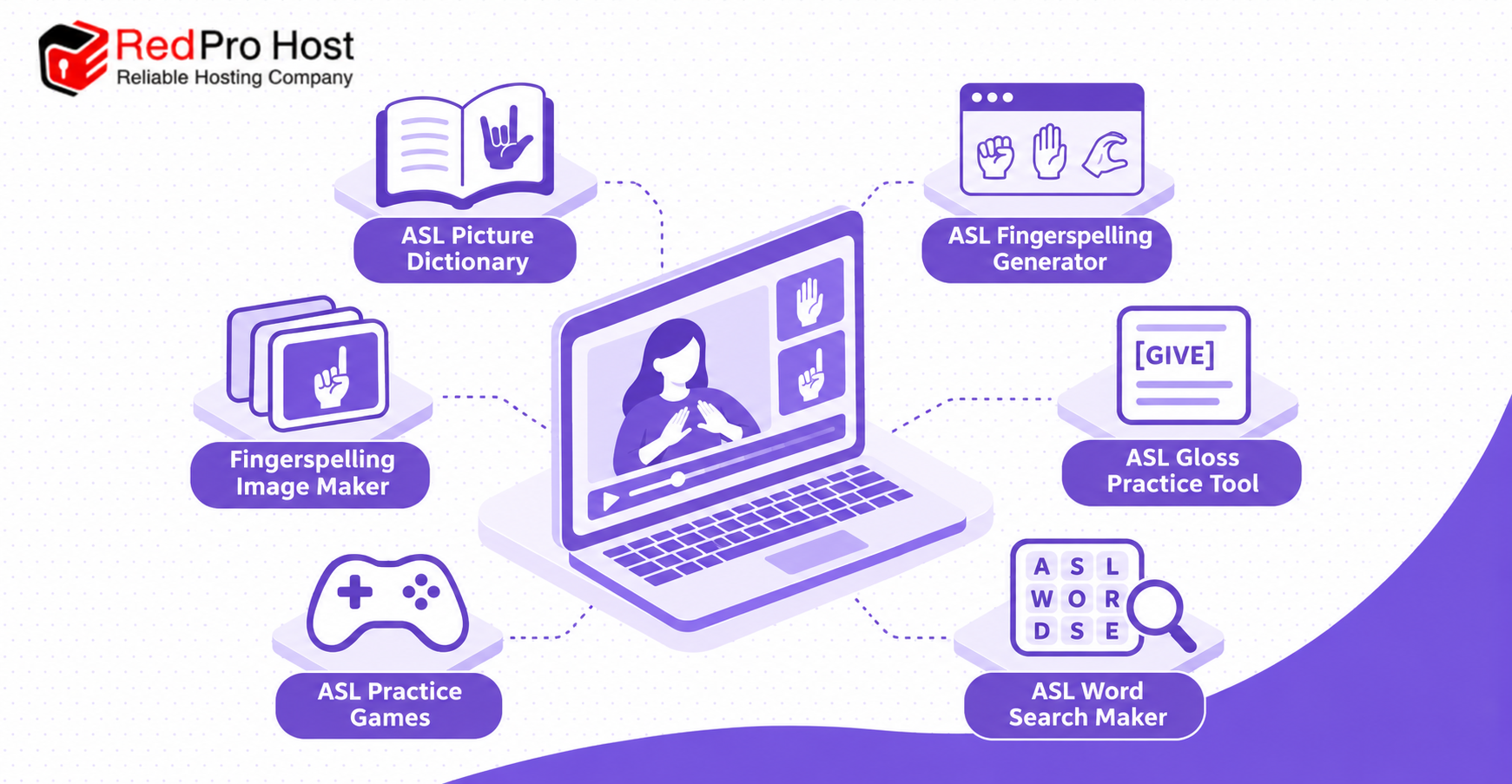
ASL Picture Dictionary
An ASL picture dictionary helps learners explore signs through visual references rather than text definitions alone. Enter an English word to find available sign images, related meanings, usage notes, and examples. This can be useful when beginning a new vocabulary topic or reviewing a sign that is difficult to remember.
Search results should be treated as starting points, not universal answers. One English word may have several meanings, and each meaning may require a different sign. Signs can also vary by region, age, community, and context. Review the complete entry and look for variation notes before practicing or teaching a result.
Pictures are convenient for showing handshape and general position, but a still image may not fully communicate movement, rhythm, facial expression, or transitions between signs. When possible, combine picture references with video instruction and feedback from fluent signers.
ASL Fingerspelling Generator
An ASL fingerspelling generator turns a typed name or word into a sequence of manual-alphabet letters. It is useful for learning how names, places, brands, abbreviations, and unfamiliar terms can be spelled by hand. The visual result can be repeated slowly until each letter becomes easier to recognize and produce.
Fingerspelling is an important part of ASL, but it is not a replacement for vocabulary. Learners should not spell every English word letter by letter when an established sign is appropriate. Use the generator for manual-alphabet practice and for words that are commonly fingerspelled in natural communication.
Begin with short words and focus on smooth transitions. Avoid dropping the hand after every letter or making each shape as a separate dramatic movement. Accuracy comes first, while speed develops through consistent practice.
Fingerspelling Image Maker
A fingerspelling image maker lets learners turn a word or name into a customized visual. Depending on the available options, users may be able to adjust size, spacing, color, layout, background, and image dimensions before downloading the result.
These images can support flashcards, presentations, vocabulary boards, classroom stations, personal study notes, or social content. A teacher might create a visual for each student’s name, while a family could make cards for frequently used words.
Before publishing, selling, or redistributing an image, review the tool’s current licensing and usage terms. Permission to download a generated file does not automatically grant ownership of every underlying illustration, font, design element, or database asset.
ASL Gloss Practice Tool
An ASL gloss practice tool introduces a written system used to discuss signs and sentence structure. A learner can enter a simple English sentence and explore how the idea might be reorganized into a learner-friendly gloss. Grammar notes may highlight topics such as time-first ordering, questions, negation, or the removal of unnecessary English function words.
Gloss is not ASL itself. It is a limited notation that uses written labels to represent some aspects of a visual language. Facial grammar, movement quality, spatial relationships, role shifting, classifiers, and other important features cannot be captured completely by a line of capitalized words.
Automated output should therefore be treated as a study prompt, not an authoritative translation. Compare important examples with instruction from qualified teachers and fluent signers before using them in a class, publication, presentation, or real conversation.
ASL Practice Games
ASL practice games can reinforce recognition, recall, vocabulary, and fingerspelling through short challenges. A game may ask learners to match signs with meanings, identify letters, remember a sequence, or select the correct answer under light time pressure.
Games work best after the underlying material has been introduced. Guessing repeatedly may produce a higher score without building dependable language knowledge. Review unfamiliar items, replay the activity later, and pay attention to which concepts remain difficult.
A score or leaderboard position is not a measure of overall ASL proficiency. It reflects performance within one activity and one scoring system. Natural communication requires a much wider range of receptive, expressive, grammatical, cultural, and conversational skills.
ASL Word Search Maker
An ASL word search maker creates printable activities based on selected vocabulary or fingerspelled words. Teachers can build a puzzle around a classroom topic, parents can prepare a short home review, and independent learners can turn a personal vocabulary list into a different form of practice.
The activity is most useful when it reinforces material that learners have already encountered visually. After finding a word, ask the learner to fingerspell it, recall its sign, use it in context, or explain its meaning. This extra step connects the puzzle to language practice instead of leaving it as a letter-search exercise.
Keep word lists short and level appropriate. A focused puzzle with familiar terms is usually more productive than a crowded page filled with unrelated vocabulary.
Find an ASL Sign
A sign-search tool offers a quick starting point when you want to explore how a word or idea may be expressed in American Sign Language. Enter a clear English keyword, review the available results, and choose the entry that matches the intended meaning rather than simply selecting the first image.
English and ASL do not have a one-to-one word relationship. For example, one English word may refer to an action, an object, or an abstract idea. Those meanings may use different signs. Reading definitions, examples, and context notes helps prevent a misleading word-for-word choice.
Search by Meaning, Not Spelling Alone
Start with the concept you want to communicate. If a search for one word produces an unclear result, try a synonym or a more specific term. Searching for “run” could refer to physical movement, operating a machine, managing a business, or participating in an election. The correct sign depends on the meaning.
This habit teaches an important principle: ASL vocabulary represents ideas within its own language system. It is not a visual code that mechanically replaces every written English word.
Review Sign Variations and Context
Two signers may use different but valid versions of a sign. Variation can reflect geography, generation, community, education, or conversational setting. A good dictionary entry acknowledges these differences and avoids presenting one version as the only possible form without evidence.
When learning a variation, note where the example comes from and who uses it. If you are preparing for a local class or conversation, ask the instructor or community members which version is common in that context.
Use Visual References as a Starting Point
A picture can help identify handshape, location, and orientation, but motion is central to many signs. Facial expression and body position can also change grammatical meaning. Treat static references as part of a larger learning process.
For a broader understanding of the language, the National Institute on Deafness and Other Communication Disorders explains that ASL is a complete natural language with its own grammar and regional variation. That context is essential when using any dictionary or automated study tool.
How to Use ASL Learning Tools
A useful practice routine connects several tools around one small goal. Instead of opening every resource at once, choose a vocabulary theme or skill, learn a limited amount, and review it in different ways. Focused repetition makes progress easier to remember and measure.
The following sequence can help beginners move from recognition to active practice without confusing fingerspelling, vocabulary, gloss, and natural signing.
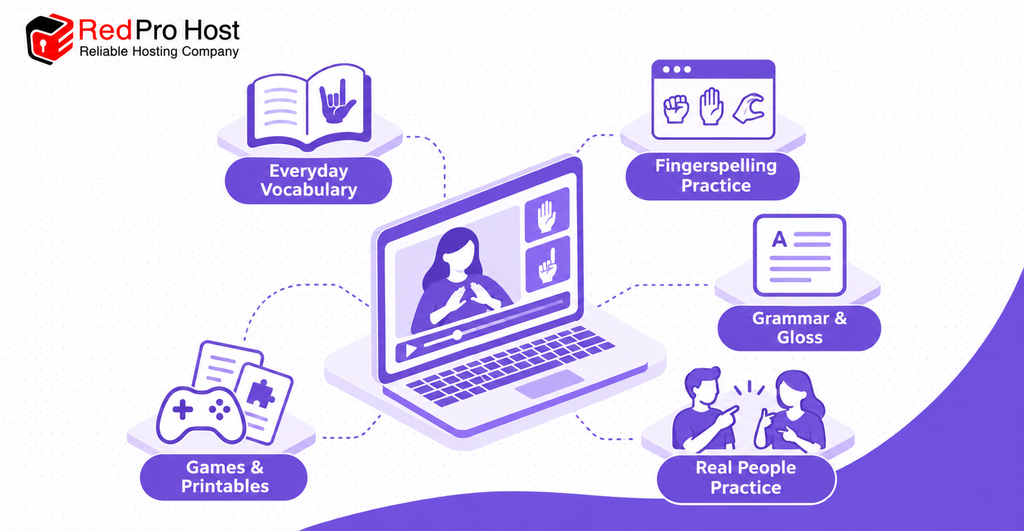
Start With Everyday Vocabulary
Choose a small set of signs connected to daily life. Greetings, family, food, school, work, time, feelings, and common activities provide practical starting points. Five carefully reviewed signs are more manageable than a list of fifty disconnected terms.
For each sign, study its meaning, handshape, palm orientation, location, movement, and nonmanual features. Then review it again after a short break. Recalling a sign from memory is more valuable than simply recognizing it while the answer is visible.
Practice the Manual Alphabet and Fingerspelling
Learn the manual alphabet in small groups instead of trying to master every letter in one sitting. Pay special attention to handshapes that look similar. Practice both expressive skills, which involve producing letters, and receptive skills, which involve understanding another person’s fingerspelling.
Names and short familiar words make good practice material. Keep the hand relaxed, form each letter clearly, and develop smooth transitions. Receptive practice should include different signing speeds and signers once the basic shapes are familiar.
Explore ASL Grammar and Gloss Carefully
After learning basic vocabulary, begin exploring how ASL organizes information. Simple topics may include establishing time, asking yes-or-no and wh-questions, using space, showing negation, and introducing a topic before commenting on it.
Gloss can help learners discuss these patterns in writing, but it should never be mistaken for the full language. Read grammar explanations alongside visual examples, and notice how facial expression and body movement contribute meaning that text cannot show.
Review With Games and Printable Activities
Use games to test recall after study rather than as the only source of instruction. A short game can reveal which letters, signs, or meanings need another review. Printable puzzles and flashcards can provide screen-free repetition and make group activities easier to organize.
Change the activity while keeping the vocabulary set consistent. You might study five signs in a dictionary, create fingerspelling cards for their English labels, play a recognition game, and then practice the signs in simple exchanges. Repetition across formats can strengthen memory without becoming monotonous.
Practice With Real People
Digital tools cannot reproduce the feedback, timing, variation, and cultural knowledge found in real interaction. Classes led by qualified instructors, Deaf-led learning opportunities, community events, and conversations with fluent signers help learners understand how the language functions naturally.
Approach community interaction with respect. A learning space is not an opportunity to treat Deaf people as unpaid practice partners. Follow event expectations, communicate at an appropriate level, and value the knowledge and time of the people involved.
ASL Tools for Beginners, Families, and Teachers
Different users need different paths through the same resources. A beginner may need a simple daily sequence, a family may want short shared activities, and a teacher may need organized materials tied to a learning objective. Clear goals keep tools from becoming an unstructured collection of links.
Beginner Learning Path
Begin with the manual alphabet and a small group of useful signs. Spend several sessions building accurate handshapes and recognition before adding more vocabulary. Next, introduce short fingerspelled words, basic questions, and simple grammar concepts.
A practical beginner sequence can follow five stages:
- Learn the alphabet and recognize common handshapes.
- Study a few everyday signs through visual references.
- Practice names and unfamiliar terms with fingerspelling.
- Explore basic sentence patterns with visual instruction and gloss notes.
- Use the language with qualified teachers and fluent signers.
Progress does not need to be fast. Consistent review and accurate production provide a stronger foundation than rushing through large vocabulary lists.
Family Practice Ideas
Families can choose one daily theme and practice together for a few minutes. A meal could introduce signs related to food, while a trip might focus on transportation or places. Repeating familiar signs in meaningful situations can make learning easier to remember.
Games and printable activities can add variety, especially for children, but the activity should remain connected to real communication. Encourage family members to use complete ideas and visual attention rather than treating signs as isolated gestures.
If a child is Deaf or hard of hearing, general online resources should not replace individualized language support from qualified professionals and Deaf mentors. Families benefit from access to rich, consistent language and informed guidance suited to the child’s needs.
Classroom Resources
Teachers can combine dictionary references, downloadable visuals, games, and printable activities around a single lesson objective. A vocabulary unit might begin with instructor-led visual modeling, move into guided practice, and finish with a short review game or word search.
Every resource should be checked before use. Review sign accuracy, regional variation, age appropriateness, licensing, accessibility, and the distinction between ASL and English. Automated gloss should not be copied directly into a lesson without qualified review.
Classroom materials should also identify what students are expected to learn. “Recognize ten food signs” is a clearer objective than “play an ASL game.” The tool supports the goal; it is not the goal itself.
Independent Study Routine
Independent learners need a routine that balances input, production, review, and interaction. Begin by watching or examining accurate examples, then produce the sign or fingerspelled word without looking. Record questions and uncertain items instead of practicing a possibly incorrect form repeatedly.
A simple weekly routine might include vocabulary on two days, receptive fingerspelling on one day, grammar and visual examples on another, and review at the end of the week. Add live or recorded feedback whenever possible.
Learn ASL With Language and Culture in Mind
ASL developed within communities and carries cultural knowledge that cannot be separated from the language. Learning only handshapes and English labels leaves out the visual grammar, shared history, norms, creativity, humor, and experiences that give communication meaning.
Respectful resources recognize Deaf people as members of diverse communities, not as problems to be fixed or as inspirational examples for hearing audiences. They make room for Deaf voices, qualified contributors, transparent review, and correction when errors are identified.
ASL Is a Complete Natural Language
ASL has its own vocabulary and grammatical systems. Meaning is expressed through handshape, location, movement, palm orientation, facial expression, body position, and use of space. These elements work together rather than functioning as optional decoration.
The language is distinct from English and is not universal. Other countries and regions use their own signed languages, such as British Sign Language. Knowing ASL does not automatically allow someone to understand every signed language.
Deaf Culture Is Part of Responsible Learning
Language learning becomes more complete when it includes the people, history, and cultural practices connected to the language. Explore Deaf history, community institutions, art, storytelling, education, technology, and current issues alongside vocabulary and grammar.
Whenever possible, prioritize materials created or reviewed by Deaf educators and fluent ASL users. Credit their work, respect usage restrictions, and avoid copying sign images or videos simply because they are publicly viewable.
Variation Does Not Automatically Mean Error
ASL includes regional accents, dialects, generational differences, and individual variation. A sign used in one area may differ from the version taught somewhere else. Context and community practice help determine whether a variation is appropriate.
Learners should ask informed questions instead of declaring one version wrong immediately. Dictionaries and instructors can explain where a sign is used, whether it is current, and whether another form is more common in a particular setting.
Online Tools Have Important Limits
An online resource can make practice easier to access, but it cannot evaluate every detail of a learner’s production or guarantee that generated content is accurate. Static images cannot fully show movement, while text-based gloss cannot represent the full grammar of a visual language.
Use technology to support lookup, repetition, organization, and creativity. Use qualified instruction and real interaction to develop receptive fluency, expressive control, cultural understanding, and conversational judgment.
How to Choose the Right ASL Tool
The best tool is the one that fits the current learning objective. A learner who wants to identify a sign needs a dictionary, while someone reviewing names needs fingerspelling practice. Choosing deliberately prevents confusion and makes each session more productive.
Choose a Dictionary for Vocabulary and Meaning
Use a picture or video dictionary when you need to explore a concept, compare meanings, or review how a sign is formed. Check definitions and examples rather than searching only by English spelling.
If the entry lacks movement, variation, or source information, confirm the sign through another reliable resource or qualified instructor before teaching it to others.
Choose a Generator for Focused Fingerspelling
Use a fingerspelling generator for names, acronyms, and manual-alphabet recognition. It can also help create short practice sets or visual cards. Do not rely on it to translate ordinary English sentences into natural ASL.
Move from static letter recognition to receptive practice with fluent movement. Understanding fingerspelling in conversation requires more than recognizing isolated handshapes.
Choose Gloss Support for Grammar Discussion
Use a gloss practice tool when studying how ASL may organize ideas differently from English. Review any accompanying grammar explanation and treat the result as a hypothesis to examine, not a finished translation.
Important communication, assignments, and published materials should receive qualified human review. Automated systems may miss context, nonmanual signals, spatial grammar, or idiomatic language.
Choose Games and Printables for Review
Use games and printable activities after vocabulary or concepts have been introduced. They are effective for repetition, recall, and variety, but they should be paired with visual language examples and active signing.
Select activities based on learning value rather than appearance alone. A simple game that tests a clearly defined skill can be more useful than a complicated activity with unclear objectives.
Frequently Asked Questions
These answers clarify what free ASL tools can do, how they should be used, and where learners need additional instruction or context.
Are the ASL Tools Free to Use?
The core tools can be available for free online use, allowing learners to search, practice, create, or play without purchasing a full course. Individual features may have account requirements, daily limits, advertisements, or separate terms for downloads and generated content.
Always review current tool instructions and licensing information before redistributing materials or using them commercially.
Is Fingerspelling the Same as American Sign Language?
No. Fingerspelling represents written letters with manual-alphabet handshapes and is one component of ASL. It is often used for names, places, acronyms, borrowed terms, or words without an established sign in a particular context.
ASL vocabulary and grammar involve much more than spelling English words one letter at a time.
Can an ASL Gloss Tool Translate English Into ASL?
An automated gloss tool can suggest a simplified written arrangement for learning and discussion, but it cannot produce a complete ASL translation. Natural translation requires context, meaning, visual grammar, nonmanual signals, spatial relationships, and cultural knowledge.
Treat generated gloss as practice material and seek qualified review for important use.
Why Can One English Word Have Multiple ASL Signs?
English words often carry several meanings. The word “light,” for example, can refer to illumination, weight, or color. Different concepts require different signs. ASL may also offer regional or contextual variations for the same general idea.
Choose a sign by meaning and context rather than by English spelling alone.
Are ASL Signs the Same in Every Region?
No. ASL includes regional, social, and generational variation. Sign choice, rhythm, slang, and production can differ among communities while remaining understandable or valid within context.
Dictionary notes, local instructors, and community interaction can help learners understand which versions are common in a particular area.
Can Online Tools Replace an ASL Class or Fluent Signer?
Online tools are useful supplements, but they cannot provide the full interaction, feedback, cultural knowledge, and visual language exposure found in qualified classes and real conversations. Learners need opportunities to understand different signers and receive feedback on their own production.
A balanced approach combines convenient digital practice with instruction and community engagement.
May Teachers Print or Download the Learning Materials?
Some tools expressly allow users to download generated images or print activities for personal and educational use. Permissions can differ by tool, and access does not always include the right to resell, redistribute, scrape, or reproduce underlying assets.
Read the applicable terms and any file-specific license before sharing materials outside the intended classroom or household.
Do Game Scores Measure ASL Proficiency?
No. A game score shows performance on a particular activity, such as matching, recognition, recall, or fingerspelling. It does not measure spontaneous conversation, receptive fluency, expressive accuracy, grammar, cultural competence, or overall language proficiency.
Use scores to identify material for review, not to label a learner’s ability.
What Should a Beginner Learn First?
A beginner can start with visual attention, the manual alphabet, fingerspelling recognition, greetings, and a small set of everyday signs. Basic cultural knowledge and the understanding that ASL has its own grammar should be introduced from the beginning.
The exact sequence can vary, but accurate practice and regular interaction matter more than rushing through a long vocabulary list.
Explore Free ASL Tools and Start Practicing
Begin with one clear goal. Search for an everyday sign, practice fingerspelling a short name, create a visual card, or review familiar material through a game. A focused ten-minute session can be more useful than opening every tool without a plan.
Return to difficult material, compare variations, and keep a list of questions for a qualified instructor or fluent signer. Use digital resources to make repetition easier while continuing to learn from the people and communities connected to the language.
Conclusion
Free ASL tools can make vocabulary lookup, fingerspelling practice, grammar exploration, visual creation, games, and printable review more accessible. A picture dictionary supports concept searches, generators reinforce the manual alphabet, gloss tools introduce written discussion of structure, and activities help learners revisit familiar material in new ways.
The tools are most effective when used with accurate expectations. ASL is a complete natural language, not a word-for-word form of English, and no static image or automated output can represent every part of it. Choose each resource for a specific learning goal, verify important information, respect variation, and combine online practice with qualified teaching and meaningful engagement with the Deaf community.